

Snap-In Dentures vs All-on-X: Why Snap-Ins Aren’t the Better Deal
Patients looking for a more stable alternative to traditional dentures often come across two very different implant-supported options: removable snap-in dentures and fixed full-arch restorations. Because both use dental implants, it is easy to assume that snap-ins offer essentially the same benefits for less money. That assumption deserves a closer look.
At Temecula Center for Dental Implants, we are getting more questions about snap-in dentures vs. All-on-X and whether the removable option is really the more economical or practical choice. The differences go well beyond whether a denture feels more secure. The number of implants, healing experience, chewing ability, jawbone support, future treatment options, and total investment can all be very different. Understanding those differences before treatment can help you make a much more informed decision.
Why are more patients asking about snap-in dentures?
We have a lot of patients calling our office lately inquiring about snap-in dentures. Patients think that it’s a better, cheaper, longer-lasting alternative to the traditional fixed All-on-X prosthesis.
Let’s revisit this subject and see why the above statement cannot be further from the truth.
What actually happens with snap-in dentures?
Snap-in dentures: We insert two implants in the lower jaw and four implants in the upper jaw. The patient has to wait 3-6 months for the implants to heal, while wearing traditional uncomfortable dentures. Once the implants heal, the dentures are modified to “snap in” to the implants, providing a somewhat more secure fit.
While the fit may be more secure, patients are still not able to eat foods that require chewing (steak, corn on the cob, chewy breads, fresh fruits and vegetables). Chewing capacity is below 40% at best initially, deteriorating further as the dentures loosen up.
This is one of the most important distinctions when comparing implant overdentures vs fixed implants. Added retention does not make a removable denture function like a fixed full-arch prosthesis.
What happens to the jawbone over time?
Patients in the meantime continue to lose bone in the areas where the implants are not present, because the snap-on dentures are not able to stimulate the jawbone enough to maintain its volume. This leads to the face sinking in and, most importantly, the inability to do the traditional fixed All-on-X procedure in the future.
All the “good bone” real estate has been taken up already by the failing implants of snap-in dentures, and the bone in other places has melted away. A treatment plan designed for a snap-in prosthesis is not necessarily the same plan we would use for fixed full-arch implants.
What if you decide you want fixed teeth later?
After spending the same amount of money as a traditional All-on-X would have cost, patients are left with a traditional denture, putting them right back where they started, except $20-30 thousand in the hole.
For patients considering snap-ins as a temporary step toward fixed teeth, it is important to ask before treatment whether the proposed implant positions will actually support the fixed restoration they may want later.
How is a traditional fixed All-on-X prosthesis different?
 Our preferred alternative is a fixed full-arch approach designed around a larger number of implants and a non-removable prosthesis.
Traditional All-on-X fixed prosthesis: Patients get 6 implants on top and 6 on the bottom. They get fixed, non-removable teeth on the day of the procedure (no wearing ill-fitting dentures for 3-6 months).
Patients are able to eat steak, fruits, vegetables, and chewy breads 3 months after the procedure, once their implants have healed. They have fixed teeth from day one of the surgery.
How does All-on-X affect the jawbone?
The bone of the jaws is not lost, as 6 upper and 6 lower implants provide sufficient stimulation to the bone to maintain it. No sunken face appearance and plenty of bone available to insert additional implants if needed.
Is fixed All-on-X always more expensive?
This is where we need to debunk one of the most common misconceptions about All-on-X and snap-in dentures. Cost is the same, and sometimes cheaper than what snap-in dentures are going for these days.
How typical lower-jaw cases compare
Let’s circle back to the cost. Let’s take a typical situation where just a lower jaw snap-in is done. Let’s say there are also 6 lower teeth that need to be removed at the same time.
In a typical snap-in denture scenario, a dentist will remove the teeth, do the bone grafts, place two implants, charge for a denture, and later charge to convert this same denture to a “snap-in” one.
This can easily end up costing the patient $10-15 thousand.
What are you actually getting for that investment?
Patients who are well informed about their options will undoubtedly consider this absolutely crazy, since a full-arch fixed All-on-6 procedure with fixed teeth starts at under $12K.
That’s 6 implants, fixed teeth, no dentures, and peace of mind knowing that you are getting the best treatment at the same or better price and that the teeth will last you a lifetime.
So why are snap-in dentures getting more attention?
It’s for all the wrong reasons, actually.
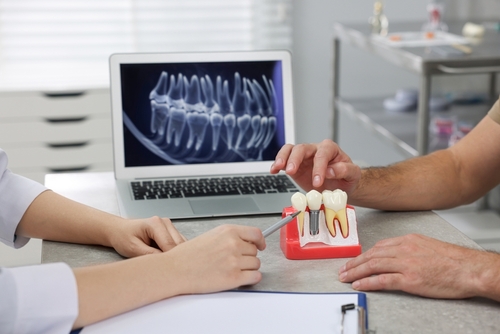 First of all, any dentist can screw in a bunch of implants into the jawbone. A lot of doctors who are fresh out of dental school and are trying to “test the waters” in implantology are being told that placing implants is easy, and “you are crazy not to do it”.
It seems like a win-win for the dentist and the companies who are pushing them to do it.
Why does fixed All-on-X require more experience?
Doing traditional fixed All-on-X requires a lot more training, expertise, responsibility, and finesse. Full-arch treatment requires coordination between implant positioning, available bone, prosthetic space, bite forces, immediate loading, temporary teeth, and the final restoration.
What role does professional liability coverage play?
In addition, not every doctor is allowed to do All-on-X. General Dentists who want to do fixed All-on-X often have to get special permission from malpractice insurance carriers just to be allowed to perform this task.
This permission requires higher insurance premiums that dentists simply aren’t willing to pay.
Why is easier treatment not necessarily the better treatment for the patient?
So they say, OK, no worries, I’ll just give everyone a snap-in denture, while charging “Fixed All-on-X” fees. To them, it’s a win-win. To the patient who was deceived, it’s a lose-lose. This is why patients should ask exactly what kind of restoration they are receiving before agreeing to treatment.
Is it removable or fixed? How many implants are being placed? What will you wear during healing? What happens if you want fixed teeth later? And what exactly is included in the total fee? Those questions can reveal much more than the phrase “implant-supported teeth” by itself.
Who can help me compare snap-in dentures vs. All-on-X & choose the best treatment option?
Whether you’re in the Inland Empire or surrounding areas, Temecula Center for Dental Implants can help you understand which full-arch treatment best fits your long-term goals. If you are not ready for fixed teeth immediately, you can also explore how a removable denture can become the first step toward full-arch dental implants. For a broader look at treatment options, visit our dental implant services and full-arch solutions.
Please do your investigative work before committing to the “snap-in” treatment. There is a better, more affordable, and more secure alternative. Don’t pay twice for your treatment—first for the snap-in and then to get things done right. We are here to help.
Contact our team today, and we’ll help you determine which approach makes the most sense for you. Let’s discuss your options today!